
Captive Finance: The Book Your Subvention Doesn’t Cover
- Industry Use Cases
 dotData
Explaining the promotional book is the simpler aspect of the captive’s portfolio. The rates are low, the credit is good, and the manufacturer covers the gap between the contract rate and the rate that the risk demands. The difficult discussion comes at a lower level: charge-offs in the near-prime program are ahead of plan, and no one at the table knows which borrowers are driving them.
All lenders—whether they are banks, credit unions, captive lenders, or independent finance companies—use the same methods when setting the prices for their non-promotional book: a credit score, a set of pricing tiers, and a rate sheet built on both. Captive lenders have the same shortcomings; the only difference is that they benefit from a subsidy which masks them in part of the book. The promotional book combines three things: a promotional rate, a strong FICO score, and a check from the manufacturer. Outside of that combination, a captive lender category has to bear the cost of the risk involved. No subsidy covers any errors.
The following discussion deals with the point at which subvention stops, what the remainder of a captive book looks like, and how to locate the parts that it misprices. Two previous posts lay out the argument—namely, that a rate sheet can be incorrect in both directions and that the buy rate carries over every scoring error—and these points apply to captives as soon as the promotion ceases.
Captive finance is when manufacturer-owned companies provide financing for the parent’s vehicles, often with rates that are subsidized by the manufacturer. The subsidy in question, called subvention, covers only part of the book. Used vehicles, standard-rate new contracts, and near-prime and sub-prime programs are priced the way any outside lender prices them.
Subvention involves a transfer. This is clearly explained in a captive’s 2016 annual filing: the manufacturer makes cash payments to the captive, which in turn enables it to offer lower payments on the contracts it purchases from the dealer network. In another parent company’s 2025 annual report, it states that when a contract is first established, the discounted value of the incentive is paid to the captive. The borrower receives a promotional rate; the captive records the contract on the basis that its financial terms include a fund transfer from the parent, arranged so that the rate remains below what the level of risk demands.
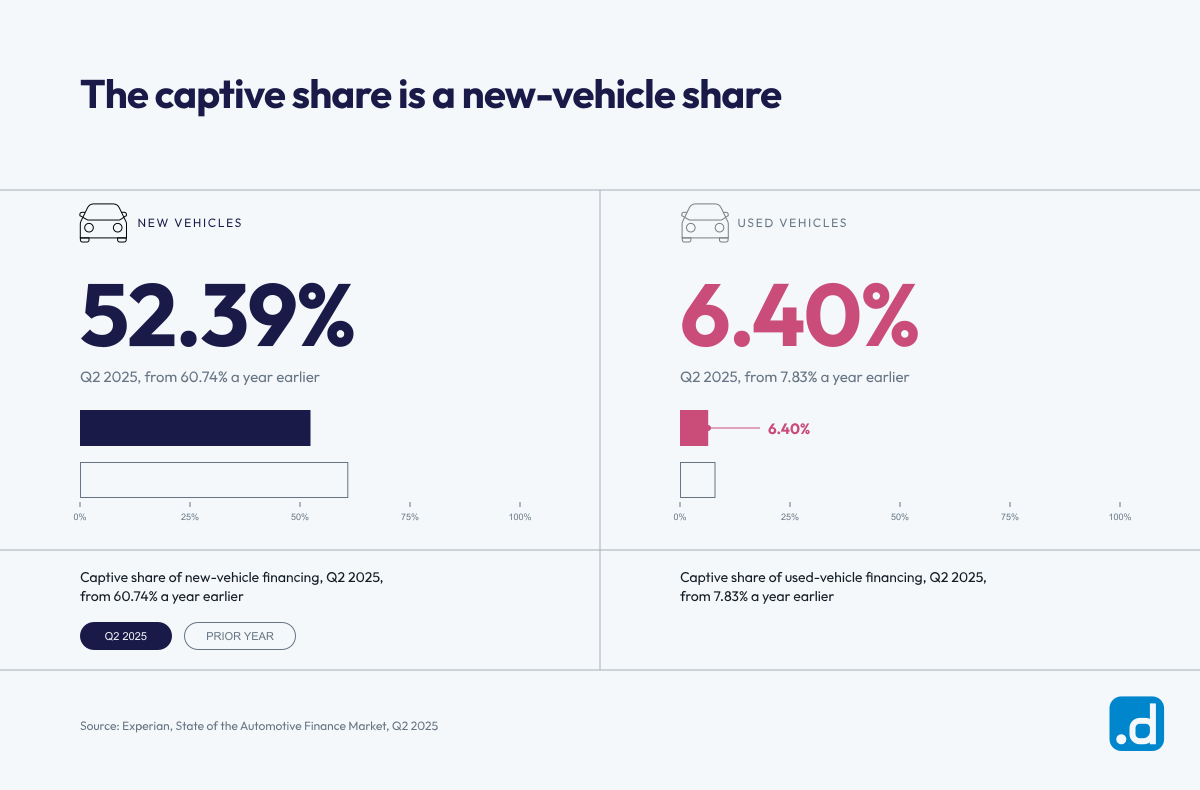
The subvention is aimed at a very specific group: new vehicles, strong credit, and special promotional terms. Experian’s data illustrates just how concentrated the results are. In the second quarter of 2025, captives accounted for 52.39% of financing for new vehicles, a decrease from 60.74% the previous year, but only secured 6.40% of the financing for used vehicles, down from 7.83% a year earlier. Overall, in Q2 2026, captives had 26.26% of the total auto financing in the market, coming behind banks, which had 27.15%, and ahead of credit unions with 20.38%.
Divide the book into subvented and non-subvented contracts and give a report showing the loss and margin for each. A blended view incorporates the subsidy into the rest of the portfolio and, as a result, makes a mispriced standard-rate segment appear to be doing better than it actually is. Therefore, two reports should be prepared rather than just one.
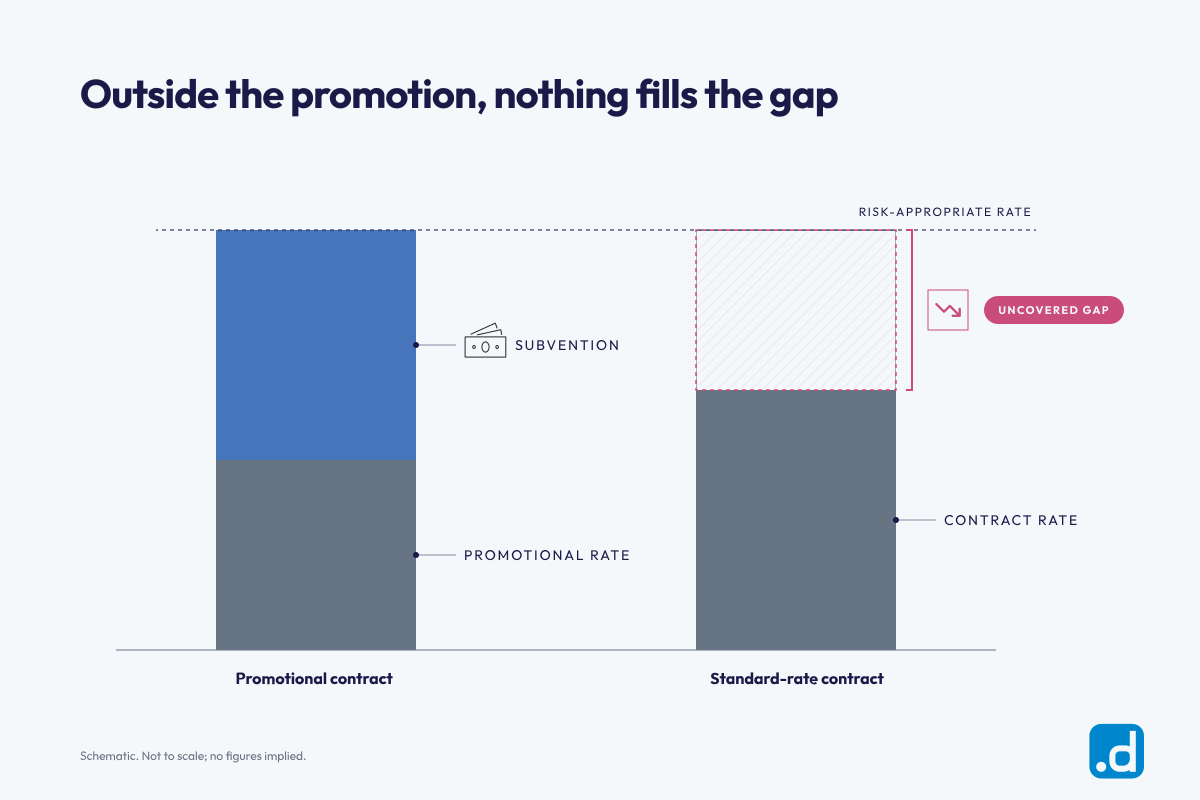
Subvention covers the gap between the promotional rate and the rate the risk requires. A loan that is mispriced while it is part of a promotion is still recorded and still appears to generate profits since the manufacturer has paid the difference. The mistake only comes to light when the captive sets its own price with no subsidy behind it.
The pricing model is never properly tested as part of a promotion. The subsidy covers the gap between the promotional rate and whatever rate the captive’s own model says the risk requires. If the model is inaccurate, then the subsidy is simply calculated on the wrong basis, and the promotional book still shows a healthy margin regardless.
Anything not covered by the promotion is priced by the same model. Whether it is a contract for a used vehicle, a loan at the standard rate, or a near-prime promotion, there is no subsidy, so the difference between the predicted and actual loss impacts the captive’s profitability. By the time the gap reaches net charge-offs, the contracts are on the books. Current data highlights the cost: in its Q2 2026 report, the New York Fed stated that the annualized flow of auto balances into serious delinquency was 3.00%, up from 2.93% the previous year.
Static scorecards make this worse. Tier cutoffs validated on development data and refreshed on a planned calendar timeline carry every error the promotional book failed to reveal straight into the standard-rate book.
Test the pricing model on subvented contracts by assuming that the subsidy had not been paid. In all cases where those contracts would have been underpriced back then, the same mistake occurs in the standard-rate book today—and none of the promotional results will alert you.
The non-subvented book is larger and riskier than the promotional book suggests. Captives run near-prime and sub-prime programs, finance used vehicles, and write standard-rate new contracts. Across all of it, they price with proprietary scores and tier guidelines, the same machinery every lender uses.
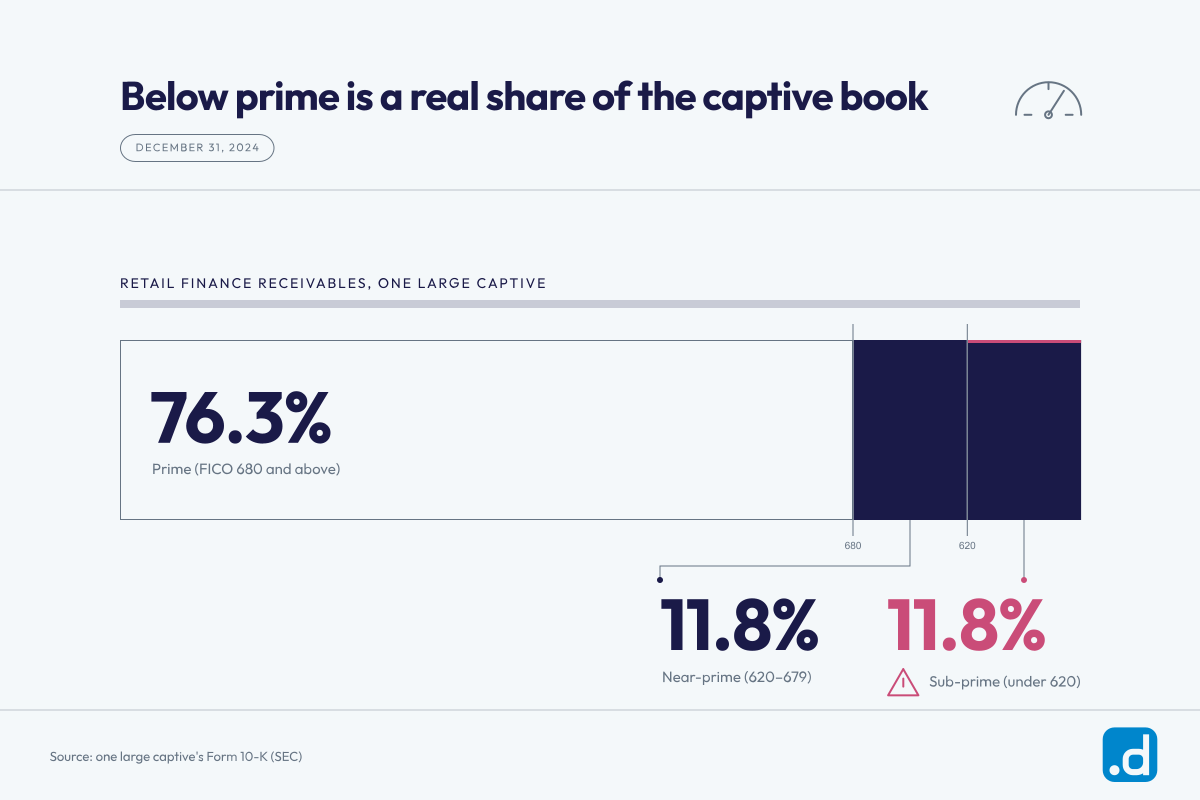
The credit mix shows this clearly: at December 31, 2024, the retail finance receivables of one large captive were 76.3% prime (defined as FICO scores of 680 and above), 11.8% near-prime (620 to 679), and 11.8% sub-prime (below 620). This captive also operates a sub-prime program aimed at buyers who have FICO scores under 620 and who have limited access to financing from banks and credit unions, and it anticipates that the program will suffer higher credit losses. This is by no means a promotional book.
The lower-credit share is growing even in new vehicles, the captives’ home market. Experian reports that the proportion of sub-prime borrowers in new-vehicle financing was 6.88% in the first quarter of 2026, which is an increase from 5.61% the previous year.
Apart from the promotion, captives operate in the same way as other financial institutions. When evaluating a credit application, another large captive uses a proprietary risk score, makes a judgmental evaluation, takes into account credit bureau data such as the FICO score, and considers the proposed terms, all while adhering to its own purchase quality and underwriting guidelines. That is to say, there is a tier structure with a judgmental element added on. Just as with other lenders, captives also buy these contracts from dealers, so the buy rate logic applies directly.
For each near-prime and sub-prime program, measure expected against actual loss by segment, not just for the program as a whole, and do it every quarter rather than at the annual model review. Program-level results average the segments together, so the segment that is running over disappears into the total.
Within the non-subvented book only, evaluate the loss your score predicted against the loss each segment actually delivered. Then look for combinations of attributes that concentrate risk the tiers average away, in particular for near-prime programs. Then reprice or restrict that segment alone.
Carrying out this process by hand in the case of a near-prime program is slow. The dotData Signal Intelligence Platform ingests application, bureau, and loan performance data, and dotData Core evaluates relational combinations across those tables to rank the Signals behind a registered metric. The most useful output for a near-prime program is the stacked result. Two examples from dotData’s documentation illustrate this pattern.
Accounts with a secured credit card tradeline in the past two years make up 4.93% of records and lift the 90-days-past-due rate from a 20% baseline to 39.3%. Accounts with an education loan tradeline in the same window make up 5.84% and lift it to 25.6%. When these two groups are combined, they represent 0.443% of the total historical volume and have a default rate of 50.0%—that is, a rise of 30 percentage points above the baseline. That stacked segment is a Precision Impact Segment: it is small enough not to affect the overall tier average but large enough to be significant for a loss budget.
Two app modules put this to work: Portfolio Pulse, anchored to 90 days past due, covers the underpriced side, and Missed Opportunities, anchored to look-to-book, surfaces yield signals, not just risk signals. All the signals are exported in the form of production SQL and are incorporated into the current knock-out rules and post-model adjustments, without the need to rebuild the loan origination system. dotData does not set rates or replace the decisioning engine.
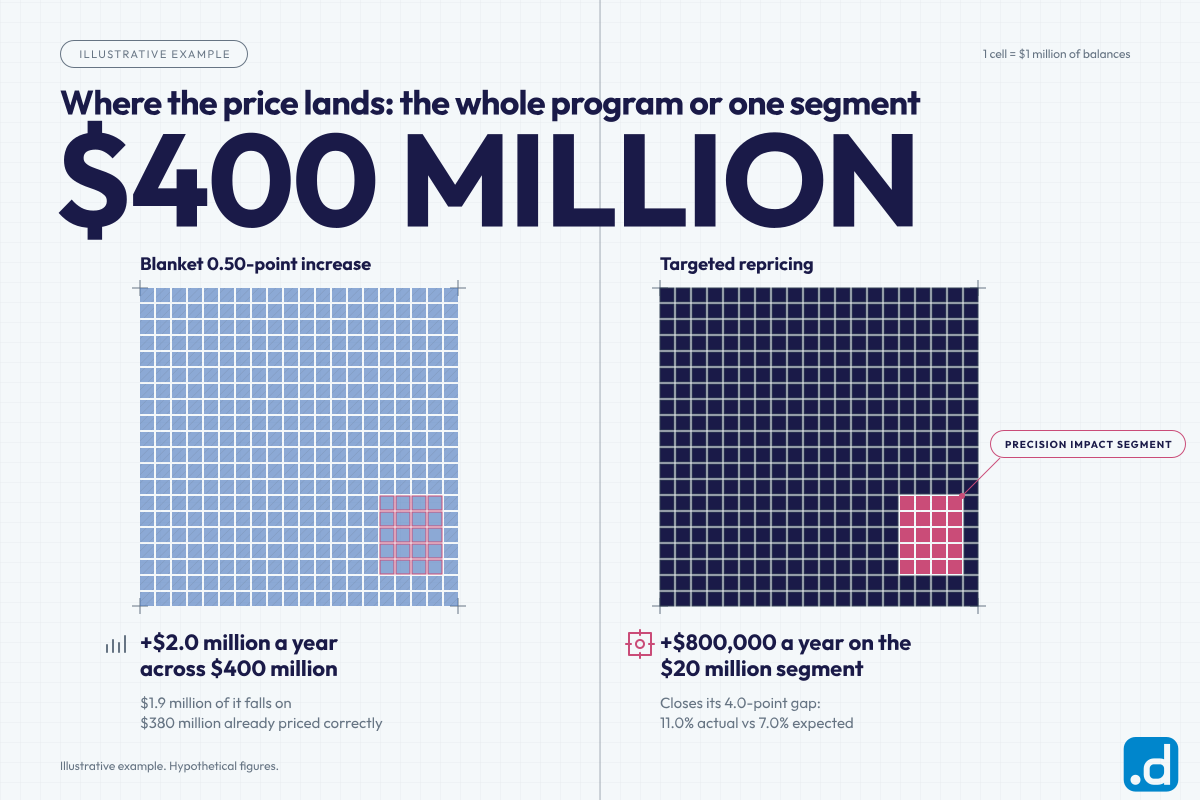
Illustrative example (hypothetical figures): A captive’s near-prime used-vehicle program holds $400 million in balances, and losses are running ahead of plan.
1: Risk proposes raising the rate by 0.50 points across the program. That brings in $2.0 million a year, but it raises the price for every borrower buying high-ticket items in the program, and volume is likely to fall across the whole book. The running tally opens at +$2.0 million a year.
2–4: Before the vote, the team compares expected and actual losses by segment. The overrun sits in one stacked segment, holding $20 million in balances, charging off at 11.0% per year against an expected 7.0%. That 4.0-point gap costs $800,000 a year, while the other $380 million is performing to plan.
5: The committee reprices only that segment, raising its rate 4.0 points and recovering the $800,000 a year. Everyone else in the program keeps the current price. The blanket increase would have put $1.9 million a year of extra fees on $380 million of balances that were already priced correctly. The problem was solved here without over-correcting; mispriced segments were adjusted without risking a drop in volume across the whole book.
Subvention has two effects: it reduces the rate for the client and at the same time conceals the errors in the pricing model for the captive. Outside of the promotion, these errors appear in the captive’s own margin—specifically in the used vehicle sector, in standard-rate contracts, and in the near-prime and sub-prime programs which make up a real share of the book.
The naive route is to raise prices across the entire book, almost certainly losing customers who don’t want to pay more than they should or who simply cannot afford the higher rates. The winning approach is to use Signal Intelligence to make a precision adjustment only where it’s needed, fixing the problem without creating a new one. Most buyers appreciate competitive rates, and maintaining this precision gives brand captives a clear advantage to expand their market share under full internal control.
Captive finance is lending by a company the manufacturer owns, set up to finance the parent’s vehicles. During promotional periods, the manufacturer subsidizes the rates that the captive lender offers; of course, outside of these promotions, they charge interest according to risk, just as any other lender would, by referring to a rate sheet which is determined by a score and a series of tiers to see if applicants qualify.
Subvention is a payment from the manufacturer to its captive that lets the captive offer a lower rate or monthly payment than would otherwise be necessary given the borrower’s level of risk. According to one parent’s 2025 annual report, it paid its captive the discounted value of the incentive at the time of origination.
Yes, but used cars only account for a small portion of their total market. In the second quarter of 2025, captives had 6.40% of the used vehicle financing, a decrease from 7.83% the previous year, as compared to 52.39% of the new vehicle financing in that same quarter.
On promotional offers, often, because the manufacturer subsidizes the rate. Outside those offers, captives price by risk with proprietary scores and tier guidelines, and their contracts come through dealers at a buy rate like anyone else’s. There is no subsidy underlying standard-rate near-prime used-vehicle loans.
They do, often at scale. As of December 31, 2024, one large captive’s retail finance receivables were 11.8% near-prime (620–679) and 11.8% sub-prime (under 620). The same captive runs a dedicated sub-prime program for borrowers with FICO scores below 620 who have limited access to financing from banks or credit unions, ensuring they are approved through customized risk parameters.
Find what your non-subvented book misprices. If you are a captive lender looking to maintain a strong partner relationship across your dealer network, precision matters.
The focus should not necessarily be on blanket rate increases. dotData helps lenders identify the segments their scores misprice and delivers each one as a rule the pricing committee can review.
Visit our website to learn how dotData provides the tools and support to deploy capital more effectively. Contact the dotData lending team.